As part of the evaluation of the project results, the digital competences of the school’s students were assessed through a survey. Identifying the students’ level of digital competence provided an important baseline for the subsequent evaluation of the project’s impact. Therefore, at the beginning of the project, we assessed the knowledge and preparedness of the participating students.
A total of 120 students from five classes in the 9th and 10th grades participated in the assessment: classes 9.a, 9.b, 9.c, 10.a and 10.b.
|
Class |
Number of participating students |
Class average |
School average |
|
9.a |
26 |
43% |
45% |
|
9.b |
24 |
36% |
|
|
9.c |
29 |
55% |
|
|
10.a |
28 |
50% |
|
|
10.b |
13 |
31% |
Significant differences were observed between the results of the individual classes. Class 9.c achieved the highest score, with an average performance of 55%, followed by class 10.a with 50%. The average score of class 9.a was 43%, while class 9.b achieved 36% and class 10.b 31%. The overall school average was 45%.
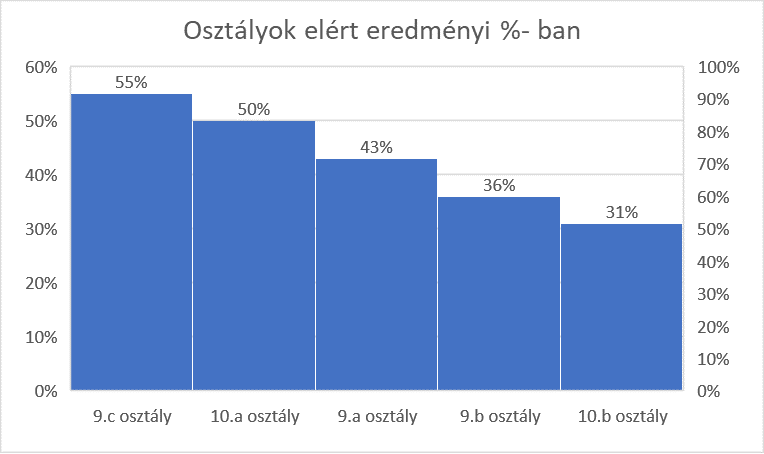
The results achieved by the two highest-performing classes, 9.c and 10.a, are also consistent with their overall academic performance. This suggests that there may be a correlation between students’ general academic achievement and their level of digital competence.
During the assessment, the students’ level of preparedness was examined in four main competence areas: internet use, safe and responsible internet use, the use of office applications and tools, and the conscious and meaningful use of social media.
|
Class |
Internet Use |
Online Safety |
Office Tools |
Social Media Use |
|
9.a |
59% |
49% |
29% |
37% |
|
9.b |
42% |
47% |
33% |
22% |
|
9.c |
66% |
69% |
41% |
43% |
|
10.a |
57% |
64% |
38% |
39% |
|
10.b |
40% |
40% |
23% |
23% |
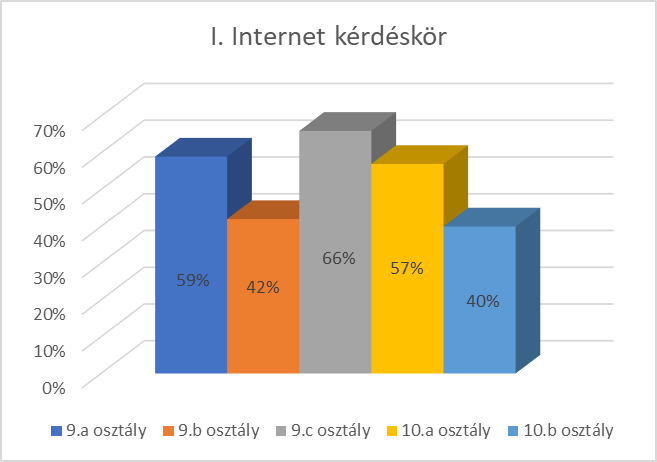
In tasks related to internet use, class 9.c achieved the highest result, with a score of 66%, while class 10.a achieved 57%. Class 9.a scored 59%, class 9.b 42%, and class 10.b 40%.
Overall, it can be concluded that the students’ basic knowledge and skills related to internet use are relatively strong.
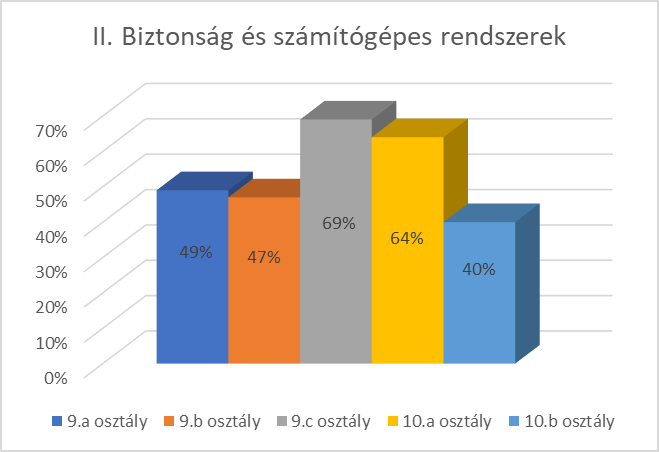
In the area of safe internet use, the results of classes 9.c and 10.a also stood out, with the former achieving a score of 69% and the latter 64%. Class 9.a achieved 49%, class 9.b 47%, while class 10.b achieved 40%.
Overall, this area can also be considered one of the students’ stronger competence areas. At the same time, the results indicate that there is still a need in some classes to further develop students’ knowledge and awareness regarding safe and responsible internet use.
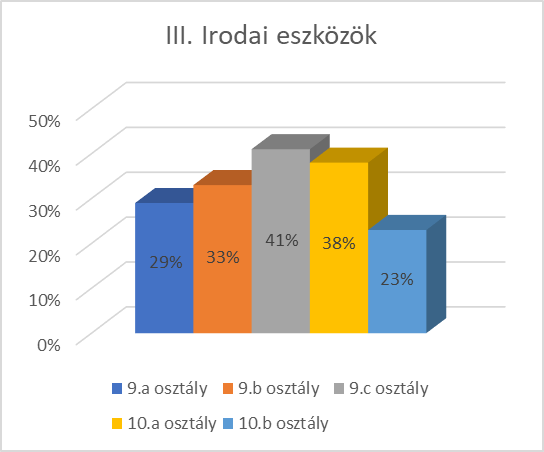
The use of office tools proved to be a less developed competence area. The highest result was achieved by class 9.c, with 41%, followed by class 10.a with 38%, class 9.b with 33%, and class 9.a with 29%. Class 10.b achieved a score of only 23% in this area.
Based on these results, improving students’ practical skills in using office applications and digital tools may be considered one of the important objectives of the project.
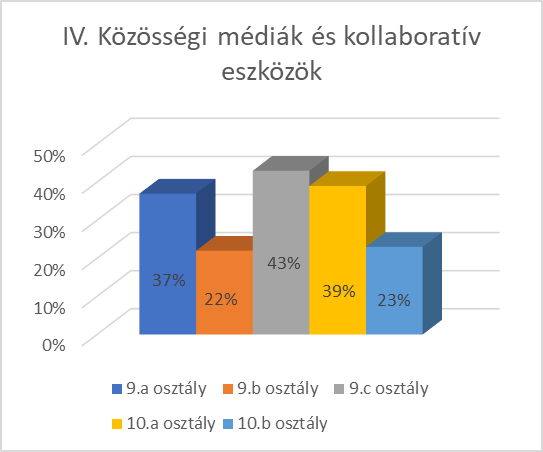
The results related to the use of social media are particularly noteworthy. In this area, all classes demonstrated relatively low levels of performance. Class 9.c achieved the highest score, at 43%, followed by class 10.a with 39%, class 9.a with 37%, class 10.b with 23%, and class 9.b with 22%.
This result is particularly surprising given that social media plays a significant role in the everyday lives of young people aged 14–16. At the same time, the assessment highlights that frequent use of social media platforms does not necessarily mean that students are able to use them consciously, meaningfully, and responsibly.